
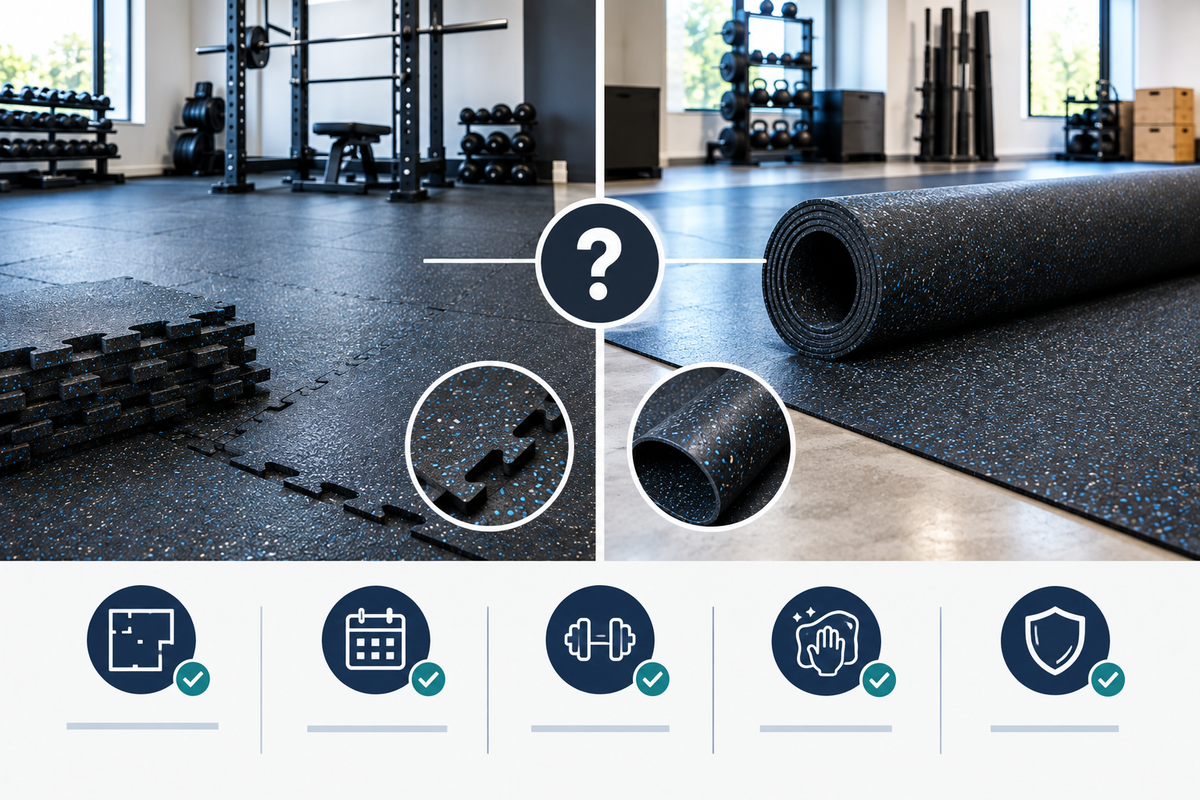
This is one of the questions we field most, and the honest answer is that neither format is better across the board. Tiles and rolls install differently, wear differently, and need different kinds of care over time. The right pick usually comes down to the shape of your room, how long you plan to stay in it, and what happens on top of the floor. Here is how we walk people through it.
Start With the Shape of the Room
Open rectangles tend to suit rolls. Rooms with support posts, angled walls, closet bump-outs, and door swings tend to suit tiles.
Interlocking gym flooring tends to be easier to work around obstacles, because you are cutting a two-foot square rather than notching a fifty-foot run. If your basement has a furnace corner and a staircase footprint to deal with, that flexibility saves both time and material. It also means a cutting mistake costs you one tile rather than a section of an expensive roll.
We have seen plenty of rectangular rooms where either format would have worked fine, so the shape of the room rarely settles the question on its own. It is just the first thing we look at, because it rules out the awkward combinations early.
Long Open Runs Favor Rolls
Rubber flooring rolls work best across long uninterrupted spans. Fewer edges means fewer places for the floor to shift, which matters under sled lanes and in corridors with steady foot traffic.
The look is also different. Rolls read as one continuous surface, while tiles show a grid if you look for it. Whether that matters depends on the space. In a member-facing area, it often does, and we have had facilities pick rolls on appearance alone. In a home garage it rarely comes up at all.
How Many Seams You End Up With

Seams are the most vulnerable part of a rubber floor. A loaded bar landing on the join between two pieces concentrates force where the material has the least support underneath it.
Rolls give you fewer seams to begin with. Tiles give you more, though each one is easy to reset if it opens up. Which you prefer usually comes down to whether you would rather have fewer seams or easier repairs. It is also worth asking where the seams will fall, since a seam outside the platform area takes far less impact than one running through it.
Getting the Material Into the Room
This is the part people tend to overlook until delivery day. Tiles arrive in boxes one person can carry up a flight of stairs. Rubber flooring rolls are heavy, need a clear path, and generally have to be brought in and unrolled in one piece.
Freight deliveries are often curbside, meaning the driver stops at your driveway rather than carrying anything inside. If your gym is in a basement or up a narrow stairwell, that one detail can settle the format question before anything else does. Measure the tightest turn on the route from the curb to the room before you order, including doorways and any landing where a long roll has to pivot.
Four Questions That Usually Settle It
When someone wants a quick answer, we ask these:
- Is the room a clean rectangle, or does it have posts and odd angles?
- Do you own the space, or could you be moving in a few years?
- Will sleds, prowlers, or heavy carts run across the surface?
- Can a long, heavy roll physically get from your driveway to the room?
Two or more answers pointing toward obstacles, a lease, or a tight entry usually point us toward tiles. A clean, open room you own with easy access usually points toward rolls. When the answers are split, we tend to weigh access most heavily, because it is the one factor you cannot work around after the truck arrives.
What a Repair Looks Like Later
It helps to think about year three before you buy, because the two formats are repaired in different ways.
With interlocking gym flooring, you lift out the damaged piece and drop a new one into the gap. The difficulty is matching it, since color and fleck can vary between production runs and rubber lightens with age and traffic. A tile ordered years later rarely blends in perfectly, which is why we suggest ordering a few extras at install and storing them flat and dry.
Patching a roll means cutting into a continuous surface and creating two fresh seams in the middle of the floor. It can be done cleanly with a sharp blade and a straightedge, though the repair is usually visible in a way a swapped tile is not.
Thickness Is a Separate Decision

Format and thickness are two separate choices.
- Under machines only, a quarter inch is generally enough, because selectorized equipment sits still.
- Light drops call for three-eighths of an inch.
- Moderate strength training with dumbbells and controlled barbell work wants a half inch.
- Heavy barbell work needs three-quarters, in either format.
Buying one step thinner to save money usually costs more in the long run, because the replacement arrives years earlier than it needed to. Whichever format you land on, match the thickness to what actually happens on the floor.
Match the Format to the Room
What works is the format that suits your room, your lease, your access, and the training you do in it. Get those four straight and the decision usually makes itself, which is why we spend more time asking about the space than talking about the product.
We stock both formats along with the adhesive, tape, and transition pieces that make either one work properly, and we help people across the Charlotte, NC region spec this out most weeks. If you would rather talk it through first, call us at 980.216.4860, and we will help you match the format to your space.