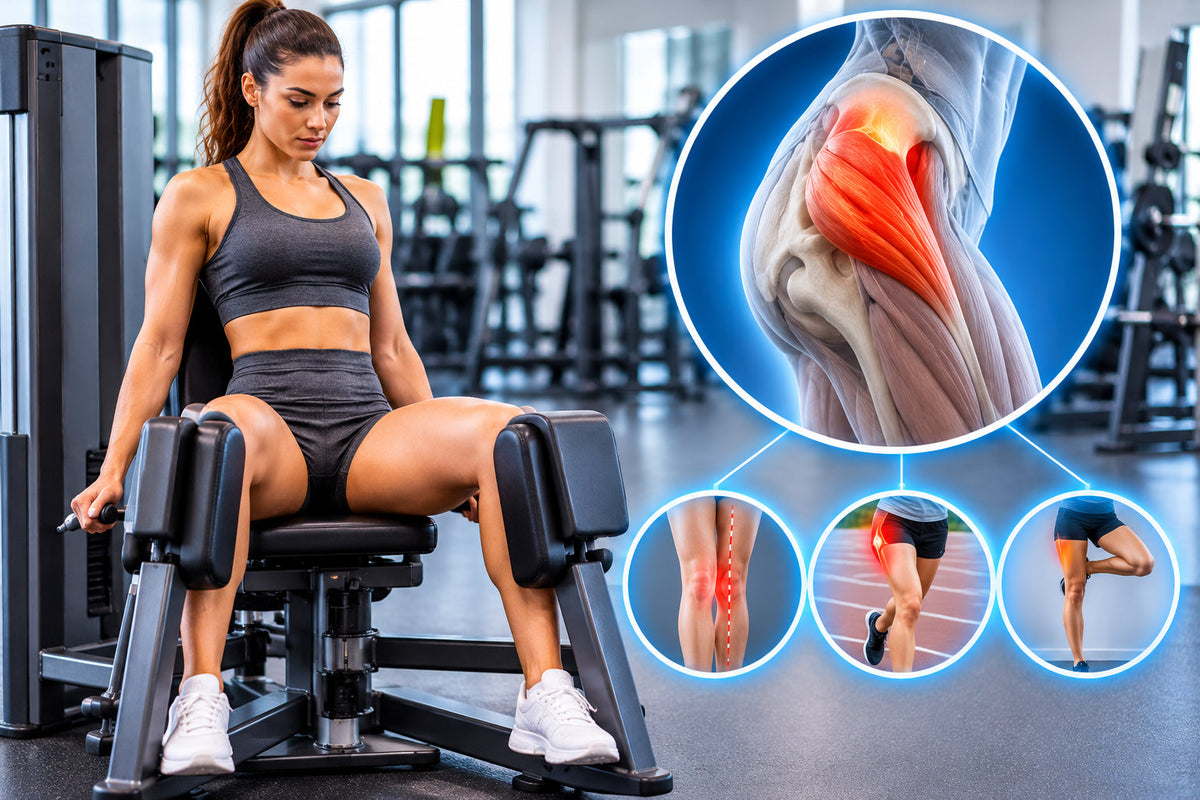
There is a piece of equipment in most commercial gyms that experienced lifters tend to walk past. Then something changes. A knee starts tracking inward on heavy squats, a hip gets sore after long runs, or a single-leg movement exposes a wobble that was not there before. The outer hip muscles are often involved, and they rarely get trained directly until something prompts it.
What Abduction Means
Abduction is the movement of a leg away from the midline of your body. The muscles that produce it sit on the outside of the hip, primarily the gluteus medius and gluteus minimus, along with the tensor fasciae latae.
They tend not to get much work incidentally. Squats, deadlifts, and presses all operate in the sagittal plane, moving forward and back, which means the muscles that control side-to-side stability get relatively little direct stimulus from a standard strength program.
Where the Weakness Tends to Show Up

The common sign is knee valgus, the inward movement people call knee cave, on the way out of a heavy squat. It often gets addressed as a cueing problem, and cueing does help, but in some cases the limitation is strength in the muscles meant to hold the femur in position.
It also shows up in single-leg work. If split squats or step-ups feel unstable in a way that does not track with your quad strength, the stabilizers on the outside of the hip are worth looking at. Ten minutes on a hip abduction machine at the end of a session is a straightforward way to work them.
Worth saying plainly: if something hurts rather than feels weak, that is a question for a physical therapist or physician, not a machine.
Why It Matters Outside the Gym
Every step you take on one leg asks the outer hip to keep your pelvis level. Walking, stairs, running, and carrying a load on one side all draw on it.
Abductor strength contributes to knee stability, which is part of why this work is relevant to a fifty-year-old who wants to keep hiking as much as to a lifter chasing a squat number. It is also why a hip abduction machine is common in physical therapy and rehabilitation settings.
How We Suggest Training It
This is accessory work rather than a main lift, and it responds better to control than to load.
- Work in the ten to twenty rep range rather than heavy singles or triples.
- Slow the return down. The eccentric portion is where a good deal of the benefit comes from.
- Pause briefly at full abduction instead of bouncing off the stack.
- Sit tall rather than leaning back, which shifts the work away from the target muscles.
- Place it at the end of a lower body day, two or three times per week.
Why We Like the Nautilus 2ST
Cable and band variations work, though they load the movement unevenly and become awkward as you get stronger. A dedicated machine holds your position so the resistance lands where it is meant to rather than being spread across whatever you are bracing against.
The Nautilus 2ST design varies resistance through the range of motion to better match where the muscle is strong and where it is not, so it is loaded at the start and the finish rather than mainly in the middle. That resistance profiling is what the old-school Nautilus line is known for.
Fitting One Into Your Space

The 2ST abductor machine runs roughly sixty-one inches high, seventy-eight inches long, and thirty-one inches wide. That is a substantial footprint, so measure the space before committing, including the room you need to get on and off it.
It suits commercial facilities, personal training studios, physical therapy settings, and home gyms with the space to spare. A well-maintained used commercial machine will often outlast a new consumer-grade version at a similar price, which is why a used abductor machine from a commercial line is usually the better value.
Accessory Work That Shows Up in Your Main Lifts
This is not something to build a program around. Leaving it out entirely, though, is one way lifters end up with a knee that caves, a hip that gets sore, and a squat that stalls for reasons unrelated to their quads. Two short sessions a week is generally enough, and the results tend to appear in the lifts you actually care about.
We stock old-school Nautilus and other commercial-grade machines at our Charlotte location and ship nationwide. Call us at 980.216.4860 to check current availability, and we will tell you what is on the floor.