
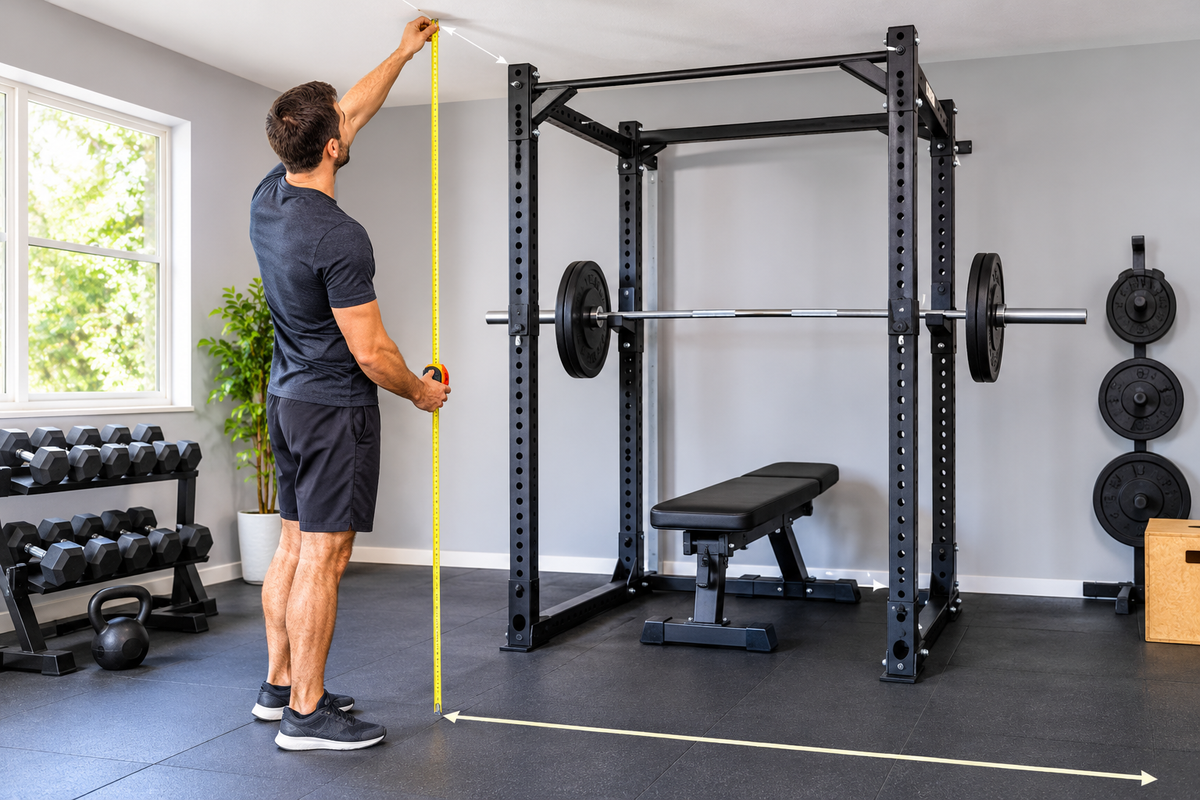
Most rack shopping starts with the product page, comparing steel gauge, hole spacing, and hardware. Then the rack arrives, and the pull-up bar sits a few inches below the ceiling, or the footprint takes up more of the garage than expected, or it turns out the slab cannot be drilled. The specifications matter, but the room decides which specifications you can use. These are the things worth checking before comparing a single product page.
Measure Up Before You Measure Across
Ceiling height rules out more options than any other constraint, and it tends to get checked last. A full-height rack needs clearance for the uprights, and then you need room above the pull-up bar to use it properly.
Overhead pressing needs more still. Stand where the rack will go, press an empty bar overhead, and see what the ceiling does. If you have eight-foot ceilings, that one measurement will shape most of what follows.
Can You Drill Into Your Floor?

Bolting down changes what a rack can do. An anchored unit handles heavier loads, resists rocking, and allows a shorter footprint to be used safely.
You cannot drill a rented slab, and drilling a floor over radiant heat or a post-tension slab without knowing exactly what is underneath is a genuine risk. If drilling is not an option, you need a free standing design with enough base to stay planted, and that is better established before you order than after.
Think About How You Train Alone
Be honest about the training you actually do. Someone squatting and benching heavy without a spotter needs full-length safeties they can set precisely, which points toward a four-post power rack enclosure.
Someone doing mixed conditioning work who wants to move in and out of the space freely usually wants something more open. Where training alone with heavy loads is the norm, a power rack is the design we recommend, since it gives you the most protection when there is nobody there to help.
Reclaiming the Floor When You Are Done
If the room is also a garage, a playroom, or anywhere a car needs to park, folding is worth serious consideration. A folding squat rack mounts to the wall and swings flat after training, which gives the floor back quickly.
The trade-off is structural. A folding squat rack has to attach to framing, so you need to locate studs and confirm the wall can carry the load. It suits narrow garages well, and it will not work at all in a room without a suitable wall.
What We Keep on the Floor

The range covers most situations we see:
- Six post cage style racks with integrated weight storage for serious home and commercial setups
- Commercial squat racks with multi-grip pull-up bars from Body Solid
- Wall-mounted racks that fold flat for shared or multi-use spaces
- Half racks and functional trainers for facilities that need cable work in the same footprint
- Used commercial cages and ladder racks when budget matters more than a new finish
Plate Storage Is Worth Paying For
Racks with plate pegs solve a problem most people do not anticipate. Plates stacked on the floor get kicked, they slow down loading, and they take up more of the room than they need to.
Pegs also add mass to the base, which improves stability on a free-standing unit. If you are choosing between two similar racks, storage is often what settles it.
The Floor Under It Matters
Whatever you bolt down or set in place needs a surface that can support it. Flooring that is too soft lets a loaded free-standing rack shift slightly on every rep, which is usually what people mean when they say a rack feels unstable.
Match the thickness to the work. A quarter inch is enough under machines that sit still, three eighths handles light drops, a half inch suits moderate strength training, and three quarters is what heavy barbell work calls for under the bar.
Buy for the Room You Have
A rack that looks right on paper is the wrong rack if it does not fit your ceiling, your slab, or the way you use the space. Measure the height, settle the drilling question, be honest about whether you train alone, and then start comparing steel.
We stock new and used commercial-grade racks at our Charlotte showroom and ship nationwide, and we are glad to go through your measurements with you before you order. Call us at 980.216.4860 and tell us about your space.