
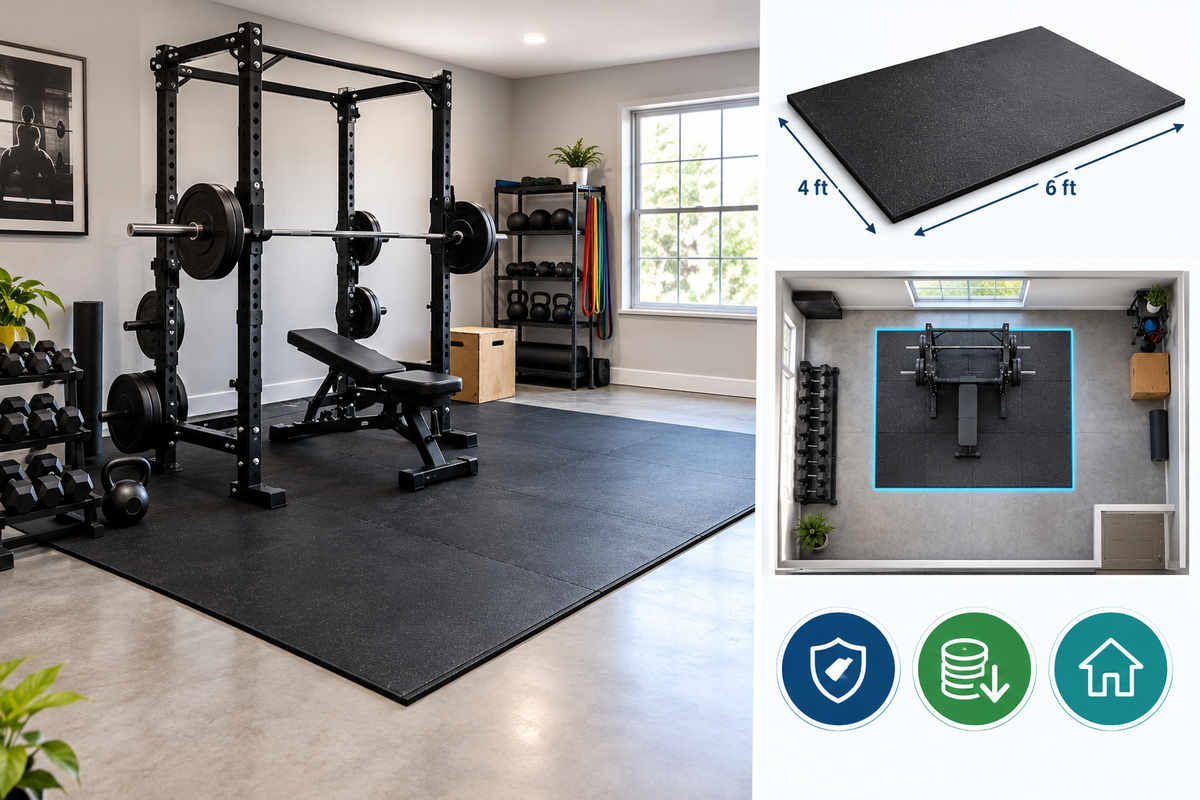
Most flooring conversations assume you need to cover the entire room. That usually holds for a commercial facility. For the average home gym, it is the wrong starting point, and it adds cost without adding much. Most people training at home use maybe a third of their floor space, and mats let you protect that part without touching the rest.
You Probably Do Not Need Wall-to-Wall
Walk your garage and mark where you actually stand. There is the rack footprint, the lifting area in front of it, a spot for the dumbbells, and a walking lane between them. The rest is storage, shelving, and empty concrete, and none of it needs rubber gym flooring laid over it.
Covering only the working zones often cuts a project cost close to half. The bare corner behind the water heater is not affecting your training, and putting rubber on it does not change that.
No Adhesive, No Permanent Commitment
This is the main appeal of the mat format. There is still an install: the mats are laid out square, cut around anything in the way, and set on a swept floor, and at four by six each is heavy enough to want a second person. What there is not is adhesive, or anything bonded down.
For renters, that matters a great deal, since nothing is bonded to a floor you do not own. For homeowners, it means the layout is not permanent, which helps when training changes and the rack moves to a different wall. It also makes rubber workout flooring something you can add to gradually rather than buying all at once.
Where Mats Work Best

The format suits some setups better than others, and the pattern is fairly consistent. These are the ones we recommend it for most often:
- Garage gyms where only the lifting zone needs protection
- Rented apartments, townhomes, and any space with a lease to consider
- A dedicated deadlift or drop zone laid over an existing floor
- Spare bedrooms and basements where wall-to-wall would be more than the room needs
- Horse stalls, warehouse work areas, and equipment pads outside the gym entirely
The Trade-Off Worth Knowing Up Front
Better to cover this before you order than after. Mats are manufactured with a small dimensional tolerance, so they will not sit together as tightly as tiles or a rolled floor. Ours run within roughly one percent on length and slightly more on width.
In practice, that means a visible line between mats. In a garage or a drop zone, that is rarely an issue, and most people stop noticing it within a week. If you want a floor that reads as one continuous surface across a whole room, tiles or rolls are the better choice, and we will say so when someone asks.
Thickness Still Decides Durability
The format does not change how much cushion the floor needs. Three-quarters of an inch is what heavy barbell work calls for, which is why that is the thickness we stock in the four-by-six size. A half inch handles moderate strength training with dumbbells and controlled lifting. Three-eighths covers light drops, and a quarter inch is enough under machines that sit still.
Buying thinner than your training calls for is usually the most expensive way to save money on rubber workout flooring. The mat wears out years earlier than it should, and in the meantime more of the impact reaches the slab underneath.
Mats Can Move With You

This is worth thinking about before you buy. A glued or taped down floor generally stays with the house, since lifting it is rarely worth the effort. Mats and interlocking tiles both float, so either can go in the truck with the rack.
The same applies to reconfiguring a room. If you decide the platform should sit against the other wall, you pick up four mats and carry them across the garage instead of pulling up an installed floor. That flexibility tends to matter more over five years than people expect at the point of purchase.
What They Are Made Of
Material is a large part of what separates flooring that holds up from flooring that hardens or holds an odor. Ours use one hundred percent USA-sourced material and are built around recycled crumb rubber, with the color-flecked versions blending in virgin EPDM for the speckle.
They carry a three-year manufacturer defect warranty and are indoor air certified. That second one matters more than it sounds in a closed garage or a basement where the air does not move much, since new rubber in an unventilated room is behind most complaints about smell. The certification covers what the material gives off, which is not something you can check from a product photo.
How Many You Actually Need
Measure the zones you marked earlier rather than the whole room. A rack and lifting area usually takes two to four mats, depending on the rack footprint and how much space you want in front of it for stepping back with a loaded bar. A dedicated drop zone is often two. A dumbbell area can be one.
Buy for the zones you use now rather than the gym you might build later. Mats are easy to add to, and nothing has to be pulled up and redone.
Cover What You Train On
Flooring does not have to be an all-or-nothing purchase. Protect the zones that take the abuse, leave the rest alone, and put what you save toward a better bar or another set of plates. That is the advice we give most home gym owners who call us, and it is usually the difference between a floor that fits the budget and one that eats it.
Take a look at our rubber gym flooring mats, or call us at 980.216.4860, and we will help you work out how many you need for your space. Orders of forty mats or more qualify for a custom shipping quote.